
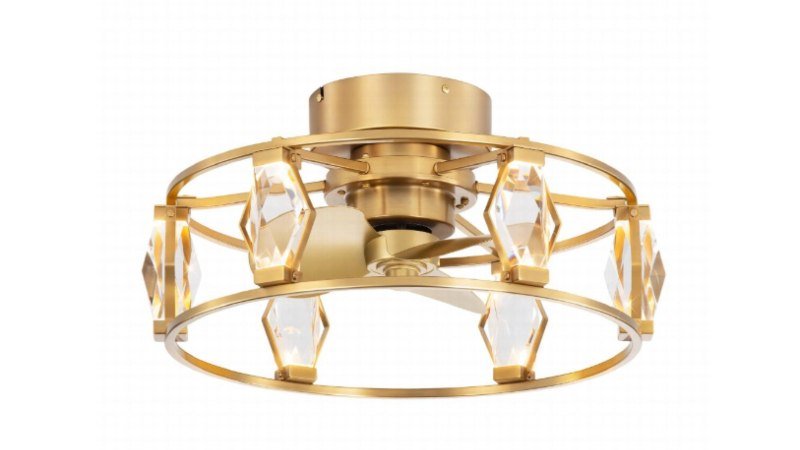
Small ceiling fans can make a compact room more comfortable without overwhelming the furniture plan. They still need careful selection, because a short blade span does not remove the need for clearance, support, useful controls, and a realistic airflow plan. Homeowners comparing small ceiling fans for compact rooms should start with the bed, desk, wardrobe, and door positions. This guide shows how to judge a compact fixture by the way the room is used rather than by diameter alone.
Measure the room around its furniture
Begin with the bed, desk, sofa, wardrobe, door swing, and tall shelves. In a small room, the usable ceiling position may be offset from the geometric center. Draw the full blade circle on the plan and check it against furniture and circulation. This simple step can reveal that a visually small fan still needs more space than the motor housing suggests.
Check ceiling height and clearance
Record the ceiling height, any slope, and the location of the electrical support. A low-profile arrangement may be appropriate in one compact room, while another may require a different mounting solution. Read the exact installation instructions and confirm blade clearance, structural support, and safe access with a qualified installer before selecting a model.
Match airflow to the occupied zone
A small fan should be judged against the area where people sit, sleep, or work. Compare the manufacturer’s room guidance and published airflow information for the models under consideration. Avoid assuming that the smallest available size is automatically best. The fixture should support the room’s main activity without being blocked by a wardrobe, loft bed, beam, or tall storage.
Decide whether the room needs a light
Some compact rooms have a complete lighting plan, while others benefit from a fixture that combines air movement and general light. Decide what the fan light would contribute before choosing a style. A desk, mirror, bedside table, or reading chair may still need a dedicated task source. Check the exact model’s light output, color temperature, and control requirements.
Keep controls simple
Small bedrooms and home offices are often used at night or while hands are occupied. Consider whether the fan and light should operate independently, where the remote will stay, and whether a wall control would be easier. Do not assume that a pre-existing dimmer or smart switch is compatible. Confirm the approved arrangement with the installer so the compact room does not gain a complicated control problem.
Use proportion to keep the room calm
A compact fixture can still become visually busy if the finish conflicts with nearby hardware or if the blade circle sits too close to other ceiling elements. Review the complete silhouette, including the canopy, motor housing, blades, diffuser, and control hardware. A finish that relates to the ceiling or furniture can make the room feel more settled without hiding the fixture completely.
Plan access and cleaning
Small rooms often have less space for a ladder or for moving furniture during maintenance. Ask how the blades and light components will be reached safely, what cleaning materials are suitable, and whether replacement parts are available. Store the care instructions and warranty information with the model details. Good access planning protects both the fixture and the room around it.
Make a compact-room shortlist
Before ordering, write down room dimensions, ceiling height, furniture positions, main activity, preferred lighting role, control needs, and installer questions. Compare only models that satisfy these conditions first. Once the practical fit is clear, choose the finish that supports the room’s visual balance. Small ceiling fans work best when they feel deliberately scaled, not merely reduced.
Allow for future room changes
Compact rooms often change function. A nursery can become a study, a guest room can become a home office, and furniture can move closer to the ceiling position than expected. Choose a location and control arrangement that will remain sensible if the room changes. A short note about future use can help the installer avoid a position that works only for today’s layout. Flexibility is especially valuable when every square foot is already spoken for.
Quick checklist
| Compact-room issue | Decision to resolve | Information to check |
| Furniture is close to the ceiling | Where can the fan sit? | Blade circle and circulation plan |
| Ceiling is low or sloped | Which mounting profile fits? | Height, support, and clearance |
| Room has a desk or mirror | Is a fan light enough? | Task lighting and light controls |
| Access is limited | How will cleaning happen? | Care instructions and service access |
Practical conclusion
The best small ceiling fan is the one that respects the whole compact room. Measure the furniture plan, confirm mounting and clearance, compare useful airflow information, and keep the controls understandable. Next step: use the checklist to remove models that do not fit the room before spending time comparing finishes.