
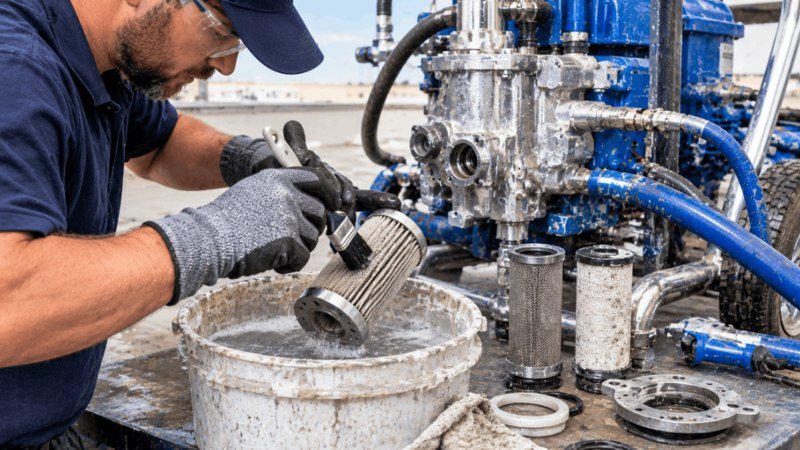
A roof-coating sprayer fails in one of three ways: the filters load up and starve the pump, the packings wear and let fluid past the rod, or coating dries inside the pump overnight. All three are preventable, and all three cost far more in lost roof time than they ever cost in parts. The routine that prevents them is short: look at the filters at every refill, watch the packing nut, and clean and protect the pump at the end of every day.
Coatings behave differently from interior paint. They are heavier-bodied, they often carry fillers or fibers, and they get applied in sun and wind on a schedule set by the weather rather than by the crew. That combination puts more load on a pump’s filters and packings than a day of repainting a bedroom ever does. This guide walks through what to check, how often, and what the manufacturers’ own manuals say about it. It leans mostly on Graco’s documentation for its Xtreme lowers and its airless sprayers because those are the machines most protective-coatings crews run, but the habits apply to any airless coating pump.
Key takeaways
- Filters protect everything downstream. A loaded filter shows up first as a shrinking spray pattern and falling output, not as a failure.
- Paint at the packing nut means worn packings. Tighten only enough to stop the leak, and plan the repair for that night.
- Where the pump uses throat seal liquid, fill it at setup and top it up daily. Stop the pump at the bottom of its stroke overnight so the coating does not dry on the rod.
- Packing material matters: leather and polyethylene stacks suit abrasive coatings, while PTFE-based stacks trade abrasion resistance for chemical resistance.
- Flush with the fluid the coating maker names, and never leave water or water-based coating in a pump that could freeze.
Why roofing work is hard on a pump
Three conditions stack up on a roof. First, the coating itself: thick material means the pump works harder on every stroke, and filled or fibrous material wears the surfaces it rubs against. Second, the climate: heat changes how a coating flows and can dry it faster inside the machine, and cold changes viscosity and brings freezing risk to anything holding water. Third, the schedule: crews run long days when the weather is right, so a machine may pump for hours without the rest a shop-based sprayer gets.
None of this means roofing pumps are fragile. Graco describes its Xtreme lowers as high-volume lowers built for protective coatings. It means small maintenance habits matter more here.
Filters: the cheap part that protects the expensive parts
Most airless coating setups have up to three filtration points: an inlet strainer on the suction side, a filter at the pump outlet or on the manifold, and a filter in the gun. The idea is simple. Anything that gets through the pump and cannot pass the tip will clog the tip, and anything lodged in a ball seat stops the pump from holding pressure. Filters keep that material out.
On Graco’s Ultra and 390 sprayers, the manifold filter takes screens in several mesh sizes. The manuals list 30, 60, 100 and 200 mesh, with finer screens for finer tips. The practical rule from the manuals is to clean the gun filter after each use and replace it if the mesh has holes. When a tip keeps clogging, Graco suggests a 100-mesh gun filter or straining the coating through nylon first. If you are shopping for a replacement Graco manifold filter housing or the screens that fit inside it, match it to the model on your machine and to the mesh your tip needs.
For heavy roof coatings, a finer screen is not automatically better. A mesh that is too fine for a thick or filled material will load up quickly and starve the pump, which is the opposite of what you want. Follow the coating maker’s data sheet for the recommended screen and the pump manual for what the machine accepts, and keep a spare of each mesh you use in the truck.
What a loaded filter looks like
- A pattern that shrinks over the day. Graco’s Magnum FAQ lists restricted filters among the causes of a smaller pattern. If the pattern narrows slowly and a new tip does not fix it, check the filters.
- Output that falls without any leak. The pump runs, the gauge looks normal, and less coating arrives at the tip. Graco’s pump-output troubleshooting lists dirty or clogged filters among the first things to check.
- Pulsing or surging at the gun. A clogged outlet filter is one of the causes Graco lists, along with a plugged tip, a hose that is too long or too narrow, and worn pump parts.
- Cap o-rings that are flattened or cracked. On Graco Xtreme lowers fitted with filter caps, the manual notes that the cap o-rings take a set at high pressure and should always be replaced when the caps come off.
Packings: reading the signs before the pump quits
Packings are the stacks of seals that keep coating inside the pump as the rod and piston move. Worn throat packings let coating creep out around the rod; worn piston packings let it slip past the piston inside the pump, so the pump loses output on one stroke. Graco gives no packing life in hours or gallons, so the honest answer to how long they last is that it depends on the coating and the machine. What you can do is read the symptoms.
| What you see | Likely cause | What to check |
| Coating on the outside of the pump, or running down from the packing nut | Worn throat packings or a loose packing nut | Tighten the nut just enough to stop the leak, then plan a repack. Inspect the rod for scoring. |
| Low output on the downstroke | Worn or open intake valve, or very thick material | Intake valve and ball seat; for thick coatings, the intake spacing the manual describes |
| Low output on the upstroke, or erratic and fast cycling | Worn piston valve or piston packings | Piston valve, piston ball and piston packings |
| Pump will not hold pressure at stall | Worn check valves or seals | Stall test: trigger off, motor should stop and stay stopped |
| Pump will not run after sitting | Coating dried on the rod | Free and clean the rod; replace packings if coating dried in them |
That second and third row come straight from Graco’s Xtreme service documentation, which ties low output on the downstroke to the intake valve and low output on the upstroke to the piston valve or packings. It is a useful way to narrow a fault without taking the whole pump apart. For a broader walk-through of what failure looks like, this guide to pump packing failure covers the warning signs in more detail.
Do not over-tighten the packing nut
It is tempting to crank the nut down hard when coating appears. Graco’s manuals warn against it: a nut that is too tight restricts the rod and overloads the motor, and the sprayer may run for five to ten minutes and then stop. The fix is to loosen the nut and replace the packings if needed. On the Ultra 395 PC, Graco says tightening the nut when the packings begin to leak buys roughly 100 more gallons before repacking is needed, which is a bridge to the end of the job and not a repair.
Choosing the right packing material for coatings
If you rebuild an Xtreme-style lower, you will meet three packing families, and the choice is more than a part-number detail. According to Graco’s Xtreme lowers manual:
- UHMWPE/leather (listed as L/PE, formerly Xtreme Seal) is the material for abrasive applications and is standard in Xtreme NXT air packages.
- PTFE (formerly Tuff-Stack) is a carbon-filled PTFE stack that favors chemical resistance and higher temperature, and the manual says it is not ideal for abrasives.
- UHMWPE/PTFE (formerly X-Tuff) favors chemical resistance and durability below 140 degrees F (60 degrees C) and is standard in Graco’s XP proportioners.
The manual does not make coating-specific recommendations, so the practical approach is to ask two questions: is the coating abrasive, and is it chemically aggressive? If you are not sure, ask the coating maker and the pump maker before you choose. For the 220cc lower, which older Graco literature calls the 900 size, the kit you need is specific to the packing family, so a listing such as the Graco Xtreme 900 repair kit should be checked against the ID plate on your lower before you order. The plate carries a six-digit number, and the packing digit in the model code tells you which stack is fitted now.
Between jobs: the cleaning and protection routine
End-of-day care is where most pump life is won or lost on a roofing crew. The steps follow Graco’s maintenance guidance and are written in the order to do them.
- Relieve the pressure. Turn the machine off, lock the gun, then follow your manual’s pressure relief procedure: trigger the gun into a grounded metal pail and open the prime or drain valve. Graco’s manuals stress that the sprayer stays pressurized until you relieve it by hand.
- Flush with the fluid the coating maker names. Water for water-based coatings, solvent for solvent-based ones. Never assume. If you flushed with water, Graco’s maintenance steps say to flush again with mineral spirits or a pump protectant so water is not left in the pump.
- Clean every filter. Pull the inlet strainer, the manifold filter screen and the gun filter. A screen packed with dried coating will not clean itself overnight.
- Fill the throat with seal liquid. On pumps built for it, throat seal liquid goes into the packing nut at setup and gets checked and topped up each day. Graco says it stops coating drying onto the rod and packings.
- Park the pump with the rod protected. The Xtreme maintenance guidance says to stop the pump at the bottom of the stroke overnight so fluid does not dry on the rod. A dried film on an exposed rod is what chews up a packing on the next start.
- Protect against freezing. Graco’s manuals warn never to leave water or water-based coating in a pump in cold weather. Store the machine where it will not freeze.
A short spares list for the truck
Roof jobs are a long way from the shop. A small box of the parts that cause stoppages turns a lost day into a short delay.
- A spare gun filter and one spare screen for each mesh size you use.
- An inlet strainer and a spare set of filter o-rings or cap o-rings for your pump.
- Two spray tips in your usual size, since a worn tip pushes more material than the pump is rated to deliver.
- A packing kit matched to the model number and packing family on your lower.
- Throat seal liquid, if your pump uses it, plus a clean pail and funnel for flushing.
- A short spare hose or whip hose, since hoses dragged across roofing surfaces take damage quickly.
A note on safety
Fluid at working pressure can pierce skin. Graco’s pump manual describes injection injuries that look like a minor cut but can lead to amputation and need surgical treatment immediately. Never put a hand, glove or rag over a leak or the tip, never point the gun at any part of the body, and lock the trigger whenever you are not spraying. If you suspect a clogged tip or hose, relieve the pressure first and loosen the tip guard or coupling very slowly. If an injection injury happens, treat it as a medical emergency.
Frequently asked questions
How often should I clean the filters on a coating pump?
At minimum, clean the gun filter after each use, which is what Graco’s manuals say, and look at the manifold filter and inlet strainer at every refill on heavy-coating days. If the pattern narrows or output drops, check the filters before you blame the pump.
Can I use a finer mesh to keep the tip from clogging?
Sometimes. Graco suggests a 100-mesh gun filter when a tip keeps clogging. But a very fine mesh can load up quickly with thick or filled coatings, so follow the coating data sheet and the pump manual, and test on a small area first.
What does it mean when the pump runs but barely moves coating?
Start with the cheap items Graco lists first: a worn or clogged tip, an empty supply, a clogged inlet strainer, and dirty fluid or gun filters. If those are clear, look at the intake and piston valves and then the packings.
Are aftermarket packings and filters acceptable for a coating pump?
Many crews use them. Aftermarket parts are made by a company other than the original maker, so check that the listing names the OEM number it replaces, and confirm the packing family suits your coating. If the machine is under warranty, ask the manufacturer before you repair it with non-original parts.
Summary
Roof-coating pumps rarely fail without warning. Filters narrow the pattern first, packings leave a film at the nut, and coating dried on the rod shows itself as a pump that will not start. A five-minute look at the filters and the packing nut at each refill, plus the same end-of-day routine every night, prevents most of the stoppages that cost a roofing crew a working day.
About the author
The eRepairCenter parts team helps painters, contractors and maintenance crews identify and replace worn parts on airless paint sprayers. eRepairCenter is a Houston, Texas supplier of aftermarket, used and surplus replacement parts and an authorized Bedford Precision distributor, shipping across the United States.