
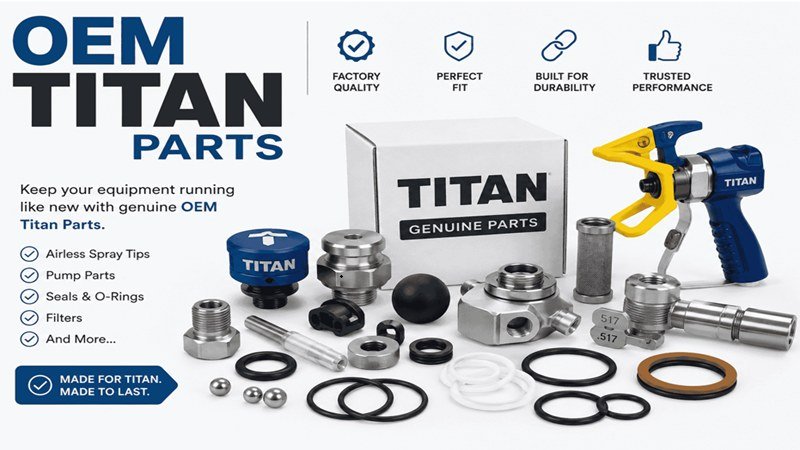
We see it happen regularly. A contractor switches to aftermarket parts to reduce costs, runs them for a season or two, and then comes back to OEM. Not because of some philosophical commitment to brand loyalty — because the math stopped working in their favor.
This pattern, repeated across hundreds of contractors over more than two decades of supplying parts from our warehouse in Houston, is the most honest answer to the question of why experienced production painters consistently use genuine OEM components for their pump wear parts. They tried the alternative. The alternative cost more in the end.
This isn’t a theoretical argument. It’s a pattern built from real operational outcomes. Here’s why it plays out the way it does.
The Job Site Doesn’t Care About Your Parts Budget
A production painter’s revenue depends entirely on machine uptime. A Titan Impact 440 that runs is billing. A Titan Impact 440 that doesn’t run is costing — crew wages, delayed job completion, customer relationships under strain, reputation at risk.
The relevant comparison when evaluating OEM versus aftermarket components is never just the purchase price. It’s the purchase price plus the downstream costs that price influences: service frequency, labor per service, downtime cost per service, and the risk premium for potential secondary damage.
Aftermarket packing kits that cost 50% less than OEM but fail in 40% of the service interval produce a higher per-gallon cost before you count the labor and downtime. Add in the risk that a prematurely failing packing kit drives abrasive material against the piston rod and turns a routine packing replacement into a rod-and-packing replacement, and the economics of the “cheaper” option deteriorate further.
The contractors who run the tightest, most profitable operations consistently use Titan OEM parts for every wear component inside the pump. This isn’t coincidental. Tight operations minimize unplanned events. OEM components minimize unplanned events. The relationship is direct.
Precision Components Require Precision Manufacturing
The fluid section of an airless sprayer pump operates under conditions that place genuine demands on component manufacturing quality.
Pressures of 1,500 to 3,300 PSI. At these pressures, dimensional tolerances that are irrelevant in low-pressure applications become performance-critical. A valve ball that is fractionally out of round doesn’t seat cleanly. The resulting leak-past reduces pump efficiency on every stroke, creates rhythmic pressure cycling that degrades spray quality, and places excess load on the packing and motor.
Cycling rates of hundreds of strokes per minute. The packing seals the piston rod on every single stroke. The surface finish of the rod, the compound formulation of the packing, and the dimensional precision of the fit between them all determine service life. Small deviations from specification in any of these variables compound rapidly at high cycling rates.
Chemical exposure to solvents, pigments, and coatings. OEM packing compounds are formulated for specific chemical compatibility with the materials Titan sprayers are designed to pump. General-purpose compounds used in aftermarket packing perform adequately with water-based products but may degrade significantly faster in contact with oil-based materials, solvents, or industrial coatings.
These are not abstract quality arguments. They manifest as concrete performance differences: service interval length, secondary damage risk, and the reliability of the machine on a job day. The Titan parts list at AllTitanParts.com — every component with the OEM part number corresponding to the manufacturer’s diagram — reflects the specificity of these requirements by model and configuration.
The Counterfeit Problem in Aftermarket Titan Components
This is the part of the conversation that doesn’t get discussed enough.
The market for Titan airless sprayer parts — particularly fluid section components for high-demand models like the Impact 440 — includes a significant volume of counterfeit and misrepresented components. These are not obviously inferior products. They are items packaged in manufacturer-resembling packaging with part numbers that look correct, sold through marketplace listings that present as legitimate parts suppliers.
The tell is the price. Genuine OEM components have a cost of manufacture that creates a floor on what they can be sold for by a dealer who is actually sourcing them through the authorized distribution chain. A component priced at 35 to 40% below the authorized dealer price for the same claimed specification is not the same component. It is a different component, manufactured to different standards, packaged to look like OEM.
Contractors who purchase from unauthorized sources and discover they received counterfeits have no meaningful recourse. The marketplace listing has moved on. The “seller” is not accountable. The component is in the machine and has already done its damage.
Purchasing from an authorized dealer — a dealer who sources through the manufacturer’s distribution chain and whose authorization creates accountability — is the practical defense against this problem. AllTitanParts.com is an authorized dealer for Titan Industries, SprayTech, Wagner, and Speeflo. The components we sell are genuinely OEM. The part numbers correspond to the manufacturer’s diagrams. The accountability is real.
What Authorized Dealer Status Actually Provides
Beyond component authenticity, authorized dealer relationships provide something that independent analysis of aftermarket products can’t: direct access to manufacturer technical knowledge.
When a component behavior question comes up — why is the machine exhibiting this specific symptom, what configuration change occurred on this model at this serial number, what is the correct torque specification for this assembly — an authorized dealer can get answers through the manufacturer. A general distributor or marketplace seller cannot.
For contractors dealing with unusual failures, older machines with production variants, or technical questions that the parts diagram doesn’t resolve, this access has real operational value. It’s the difference between a phone call that resolves the issue and hours of troubleshooting from first principles.
The Shelf Stock Discipline
One consistent characteristic of operations that rarely experience emergency downtime from pump failures: they keep repacking kits and valve assemblies on the shelf before they need them.
The emergency isn’t the pump failing — that’s normal wear. The emergency is the pump failing at 7 AM on a job day when the crew is staged and the customer is expecting a finished wall by end of day. That scenario is entirely preventable with $100 in parts sitting in the shop van.
The contractors who’ve run Titan equipment for years, who’ve learned from a few mid-job failures early in their career, universally develop a shelf stock discipline: one packing kit per machine in the fleet, one inlet valve, one outlet valve, a spare manifold filter, a bottle of pump armor. These are OEM components from an authorized dealer, purchased during scheduled service rather than in a crisis.
The psychology matters too. When you know you have the parts to fix the problem, a pump failure mid-job is a one-hour repair that the crew works around. When you don’t have the parts, it’s a crisis that defines the rest of the day. The operational difference between those two scenarios is entirely about preparation.
The Long Answer to a Simple Question
Why do experienced contractors keep coming back to OEM Titan parts?
Because they’ve done the math, consciously or through accumulated experience. OEM components for wear parts inside the pump produce lower total cost of ownership over time — through longer service intervals, lower secondary damage risk, and more predictable maintenance schedules that allow for planned downtime rather than emergency downtime.
Many professionals prefer genuine components because they have experienced the consequences of using counterfeit or low-quality aftermarket alternatives. They have paid the price through unplanned downtime, secondary equipment damage, and hours spent diagnosing problems that ultimately came from a component that failed to meet specifications.
Because the operational risk of mid-job pump failure is not distributed symmetrically. The cost of a failure at the wrong moment — start of the busy season, middle of a large commercial job, opening day of a new contract — is vastly disproportionate to the price difference between OEM and aftermarket on any individual component.
Saving $20 on a packing kit does not justify the risk of losing a $500 workday, damaging a customer relationship, or scoring a piston rod that turns routine maintenance into a costly fluid section rebuild.
Nnanna Otuonye is the founder of AllTitanParts.com, an authorized OEM dealer of Titan, SprayTech, Wagner, and Speeflo airless sprayer parts located at 5250 Gulfton St, Suite 1H, Houston, Texas 77081. With over 20 years in the spray equipment industry, he supplies painting contractors and industrial coating professionals across the United States with genuine factory parts and same-day shipping.