
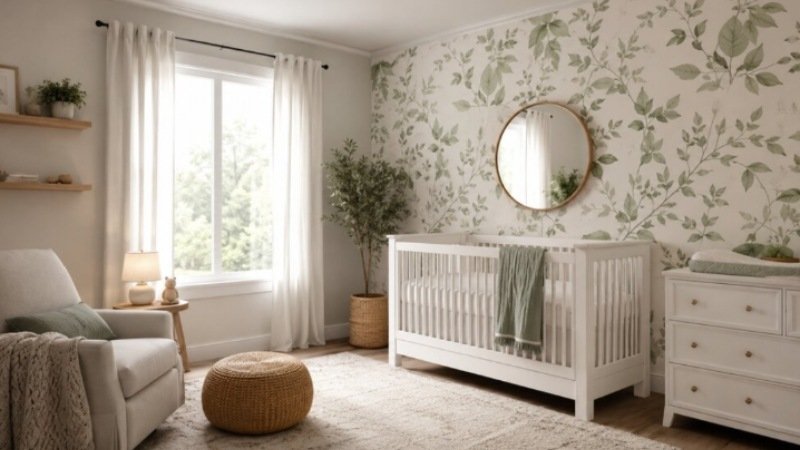
Decorating a nursery is one of the most exciting parts of getting ready for a new baby. But before you fall in love with that dreamy botanical print or the perfect pastel cloud pattern, there’s a question every parent should ask first: is this wallpaper actually safe for a baby’s room?
Between VOC emissions, adhesive chemicals, and the simple reality that little hands (and eventually toddler mouths) end up touching everything, nursery walls deserve a bit more thought than a typical bedroom. Here’s what to look for so your baby’s room is as safe as it is beautiful.
Why Nursery Wallpaper Safety Matters More Than You’d Think
Babies spend an enormous amount of time in their nursery — sleeping, napping, and eventually crawling around exploring every inch of the room. Their lungs, skin, and immune systems are still developing, which means they’re more sensitive to airborne chemicals than adults are.
Traditional paint and wallpaper products can off-gas volatile organic compounds (VOCs) for weeks or even months after installation. In a small, enclosed nursery, that matters a lot more than it would in, say, a garage or a hallway. The good news: today’s wallpaper market has far better options than it did even five years ago.
Look for Low-VOC or VOC-Free Materials
This is the single most important factor. Many modern non-woven and paper-backed wallpapers are manufactured with water-based inks and low-VOC or VOC-free formulations. When you’re shopping, ask specifically:
- Is the wallpaper itself low-VOC or VOC-free?
- What kind of adhesive or paste will be used during installation?
- Does the product have any third-party certifications (such as GREENGUARD Gold, which specifically evaluates products for use in schools and healthcare settings — a good proxy for “safe around sensitive lungs”)?
If a seller can’t answer these questions clearly, that’s a sign to keep looking.
Peel-and-Stick vs. Traditional Wallpaper for Nurseries
Peel-and-stick wallpaper has become hugely popular for nurseries, and for good reason — it’s often easier to remove without damaging walls, which matters if you’re renting or planning to redecorate as your child grows. However, not all peel-and-stick products are created equal. Cheaper versions can use stronger adhesives that off-gas more than a professionally installed, wallcovering-grade product.
Traditional (non-woven or vinyl) wallpaper, installed properly with a breathable, low-VOC paste, tends to have better long-term durability and a cleaner finish — especially in a room you plan to keep as a nursery-turned-big-kid-room for several years.
Choose Washable, Scrubbable Surfaces
Nurseries get messy. Between diaper changes, spit-up, and — a few years down the road — crayon experiments, you’ll want a wallpaper that can handle a damp cloth without staining or peeling. Vinyl-coated and Type II commercial-grade wallcoverings are typically the most scrubbable options, which is why they’re often used in nurseries even though they were originally designed for high-traffic commercial spaces.
Watch the Details Around Cribs and Changing Tables
A few practical safety notes that have nothing to do with the wallpaper material itself, but everything to do with nursery safety:
- Keep wallpaper seams and edges smooth and fully adhered — loose corners are tempting for curious toddlers to pick at
- Avoid placing a crib directly against a wall with a textured or 3D wallpaper finish, since babies can get surprisingly close to walls as they grow and start standing
- If you’re using a mural or an accent wall, make sure it’s installed by someone experienced with pattern matching — a poorly matched seam is the first thing your eye catches every time you walk in
Why Professional Installation Matters for Nurseries
It’s tempting to DIY a nursery wallpaper project, and plenty of parents do it successfully. But there are a few reasons a professional installer is worth considering for this particular room:
- Proper ventilation and dry time — an experienced installer knows how long a room needs to air out before it’s safe for a newborn to spend time in it.
- Correct adhesive selection — not every paste is appropriate for every wallpaper backing, and using the wrong one can trap moisture or increase off-gassing.
- Clean, tight seams — fewer loose edges for little fingers to find.
As Kris A., Co-Founder and Design Consultant at Enjoy The Wall a member of both the Wallcovering Installers Association (WIA) and the Interior Design Society (IDS), who works closely with leading wallpaper manufacturers to help clients select the right materials for each project, explains:
“Nurseries are one of the rooms where I tell parents not to cut corners on material quality or installation. It’s a small space where a baby will spend thousands of hours, so we’re always steering families toward low-VOC, scrubbable materials and making sure the room has proper time to air out before the crib goes in.”
A Few Nursery Wallpaper Style Ideas That Work Well
If you’re still narrowing down a look, a few styles tend to age gracefully as your child grows from infant to toddler to big kid:
- Soft botanicals and leaf prints — calming, gender-neutral, and easy to build a room around
- Muted pastel patterns — clouds, stars, or simple geometric shapes that don’t feel “babyish” by the time your child is five
- Textured neutrals — grasscloth-inspired or subtle textural wallcoverings that add warmth without overwhelming a small room
The Bottom Line
A nursery is one of the most personal rooms you’ll ever decorate — and also one where material safety genuinely matters.Look for low-VOC or VOC-free products, ask which adhesive the installer will use, and don’t be afraid to hire a professional installer who works with these materials regularly.Your baby (and your own peace of mind) will thank you.
Have questions about safe wallpaper options for a nursery or any other room in your home? Professional installers who specialize in residential wallcoverings can walk you through material options, VOC ratings, and what will hold up best for your family’s needs.