
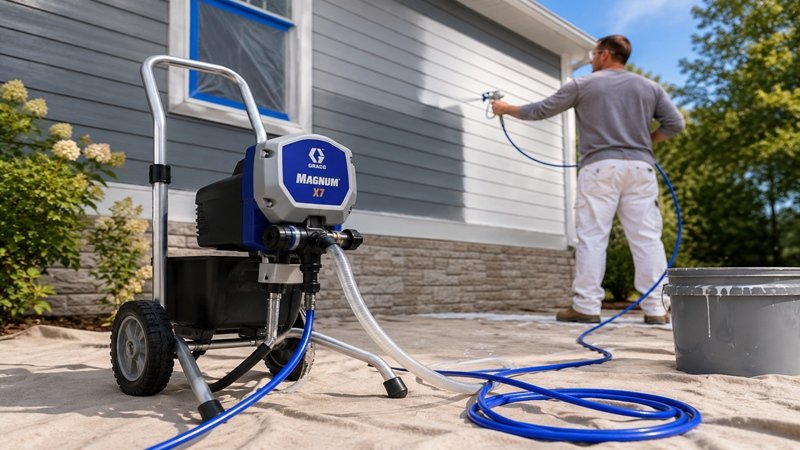
There’s a specific moment most DIYers hit: they’ve owned a smaller sprayer for a year or two, and it’s handled fences and interior rooms fine, but a whole-exterior repaint or a run of thicker elastomeric coating leaves it straining and the job dragging into a second weekend. That’s the gap the magnum x7 airless paint sprayer is built to close — not a replacement for an entry-level machine, but the next step up for anyone whose projects have outgrown one.
What the X7 Is Actually Built For
The X7 sits at the top of Graco’s homeowner Project line, and the design choices reflect that positioning. Where a smaller stand-mounted unit is meant for occasional use, the X7 adds a wheeled cart, supports a larger 0.017″ tip, and pushes a higher flow rate — 0.31 GPM versus 0.27 on the entry-level model. On paper that sounds like a modest bump. In practice, on a full exterior with thicker latex or elastomeric coating, it’s the difference between a machine that keeps up all day and one that’s constantly fighting to hold pressure.
- Wheeled cart design — push it around a job site instead of carrying it, which matters over a full day
- Larger tip capacity handles thicker coatings without the pump laboring
- Up to 100 feet of hose, useful for two-story exteriors or larger lots without repositioning
- Same PowerFlush cleanup system as smaller Magnum models, so the maintenance routine carries over
The Jobs Where the X7 Earns Its Price Difference
Full exterior repaints are the clearest case. Siding, trim, and fascia in one pass benefit from the higher flow rate — you’re moving more material per minute, which on a large house adds up to real time saved, often the difference between finishing in a weekend or bleeding into a third day. The wider tip range also matters here, since exterior coatings often run thicker than interior wall paint, and a smaller tip forces you to either thin the material more than you’d like or accept a strained, inconsistent pattern.
Elastomeric and masonry coatings are the other clear use case. These materials are notably thicker than standard latex, and they’re exactly where entry-level sprayers start to bog down. The X7’s stronger pump handles them without the constant pressure drops that turn a coating job into a maintenance headache.
Frequency matters as much as job size. If you’re painting several properties a year — a landlord managing multiple units, a serious flipper, or simply a homeowner who takes on a lot of side projects — the X7’s build is sized for that higher duty cycle in a way a smaller machine isn’t, and the time saved across a season adds up fast.
Setting Up the X7 for a Big Job
A few setup habits make a real difference in how the X7 performs on larger projects:
- Match tip size to coating thickness — don’t default to a smaller tip out of habit; the X7 runs larger tips efficiently
- Strain every batch of coating before it goes in the bucket, especially elastomeric products that tend to carry more debris
- Prime fully before starting, and re-prime if the machine sits idle for more than 15–20 minutes mid-job
- Keep the cart on level ground where possible — it keeps the suction tube properly seated in the pail
Maintenance at a Higher Duty Cycle
Because the X7 tends to see more total hours of use than a smaller sprayer, the maintenance cadence should be a little tighter. Filters clog faster when you’re moving more material, so checking the gun filter and inlet strainer every session — not just weekly — is worth the two minutes it takes. The same flush-immediately rule applies, but on longer job-site days it’s easy to let the machine sit between the last coat and cleanup. That gap is exactly where packings dry out and pumps start priming poorly.
Wear parts follow a familiar pattern — tips wear wider over time, filters clog, and the prime valve is the most common point of failure after storage — but because the X7 typically logs more hours, replacement intervals tend to come sooner. Keeping a spare tip and a prime valve kit on the shelf avoids a mid-project scramble that can cost an entire day.
X7 or a Smaller Sprayer — A Quick Gut Check
If most of your projects are single features — a fence, a shed, one room — a smaller sprayer is still the more sensible buy. The X7 makes sense once you’re regularly doing full exteriors, working with thicker coatings, or painting frequently enough that the extra flow rate and cart mobility save real time across the season rather than on one project. Still weighing the two? A side-by-side graco x5 vs x7 comparison lays out exactly where the extra cost pays off and where it doesn’t.
For anyone already leaning toward the upgrade, the math is straightforward: one or two full-exterior jobs usually recover the extra cost through the time they save. If you’re ready to stop wrestling with a machine that’s undersized for the job, Graco built the X7 to keep pace with everything a serious exterior season throws at it.
Frequently Asked Questions
Is the X7 significantly heavier than smaller Magnum models?
It’s heavier on paper, but the wheeled cart offsets that in practice — you’re pushing it, not carrying it, which is easier over a full day on a job site.
Can the X7 spray elastomeric coatings without thinning?
It handles them significantly better than smaller sprayers thanks to the larger tip range and higher flow rate, though checking the coating manufacturer’s sprayer guidance is always worth doing first.
How much hose does the X7 support compared to smaller models?
The X7 supports up to 100 feet, which matters most on two-story exteriors or larger properties where repositioning would otherwise eat into your day.
Do X5 and X7 share replacement parts?
Many wear components overlap, but not all — pump kits and some tip-related parts are model-specific. Confirming compatibility against your model’s series before ordering avoids a returned part.