
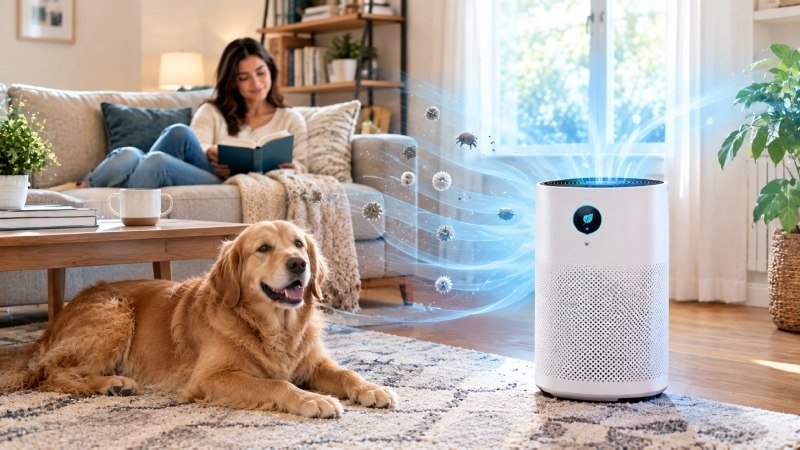
The Hidden Layers Dust Leaves Behind Every Week
Dust does not vanish after a Saturday cleaning session; most of it simply resettles once the room’s air currents shift. Skin cells, textile fibers, pollen, and pet dander stay suspended in the air far longer than most people expect, riding thermal currents created by heating and cooling systems. When the furnace kicks on or someone opens a window, that suspended material lands back on shelves, screens, and upholstery within hours. Homeowners often assume a clean house means clean air, but the two are only loosely connected, and the gap between them explains why the same surfaces need wiping down every few days.
Wiping surfaces and running a vacuum only manages the dust that has already settled, not the particles still circulating overhead. Fine particulate matter, small enough to bypass nasal filtering, can remain airborne for hours before gravity finally pulls it down. That category includes pollen fragments, mold spores, and the microscopic debris shed by carpets and mattresses over time. For people with asthma or seasonal allergies, this constant low-level exposure can trigger symptoms even in a home that looks spotless. The visible layer on a coffee table is only a fraction of what is actually moving through the air at any given moment.
Turning Airborne Dust Into a Solvable Household Task
Once it becomes clear that surface cleaning alone will not solve the problem, attention naturally shifts to the air itself. Many households start researching how to eliminate dust with air purifiers, since a dedicated filtration unit addresses the particles that settle right back onto furniture after every cleaning pass. The appeal is straightforward: instead of chasing dust after it lands, a purifier intercepts it while it is still suspended, pulling it through a filter before it has a chance to redistribute. This shifts the whole cleaning routine from reactive to preventive, which matters most in bedrooms and living rooms where people spend the bulk of their time.
Most air purifiers rely on high-efficiency filters that trap particles as small as 0.3 microns, catching everything from dust mite debris to fine soot. Continuous operation matters more than raw power; a unit that runs quietly for hours captures far more material than one switched on only during obvious flare-ups. Fan speed and placement also affect performance, since a purifier tucked behind furniture pulls in less air than one positioned where airflow is unobstructed. Running the unit near where dust accumulates fastest, such as a carpeted bedroom or a room near an open window, tends to produce noticeable results within the first few weeks of consistent use.
Reading Filter Specs Before You Commit to a Unit
Before choosing a purifier, it helps to check its Clean Air Delivery Rate against the actual square footage of the room, since an undersized unit will run constantly without ever keeping pace with dust generation. Filter replacement schedules matter just as much as the initial rating, because a clogged filter loses efficiency well before it looks visibly dirty. The EPA indoor air quality guidelines offer a useful benchmark here, outlining how ventilation, filtration, and source control need to work together to lower indoor particulate levels rather than treating a purifier as a standalone fix. Noise output is worth testing too, since a unit too loud for nighttime use often gets switched off when it is needed most.
Placement inside the home makes a measurable difference as well; a purifier positioned in a hallway rarely does much for a dusty bedroom down the corridor. Pairing filtration with basic source control, like washing bedding weekly and reducing wall-to-wall carpeting, tends to compound the benefit over time. Pet owners should factor shedding season into their expectations, since dander levels can spike well beyond a unit’s baseline capacity during certain months of the year. None of these adjustments require major renovation, just a closer look at where dust actually accumulates and how air moves through each room.