
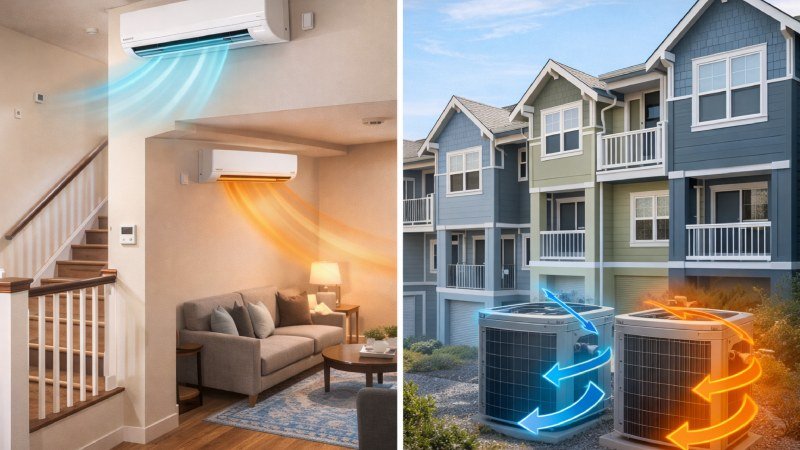
Long open hallways can make a home feel spacious and connected, but they can also create noticeable comfort problems when air does not move evenly from one area to another. Some rooms may feel too warm, while others stay cooler than expected, even though the HVAC system is running normally. This happens because open hallway layouts can change how supply air travels, how return air circulates, and how pressure shifts across the house. An HVAC contractor helps identify these imbalances and improve distribution so the home feels more consistent, comfortable, and usable throughout the day and across changing seasons.
Hallway Airflow Challenges
Long Hallways Can Pull Conditioned Air Away from Nearby Rooms
An HVAC contractor helps improve air distribution by recognizing that long, open hallways often serve as central pathways for air movement, rather than neutral spaces between rooms. When conditioned air enters the house through nearby vents, it may drift down the hallway instead of settling evenly into bedrooms, offices, or living areas that need it most. This can leave some spaces underconditioned while the hallway itself feels more comfortable than the rooms connected to it. The issue becomes more noticeable when doors stay open, ceiling heights vary, or large openings connect one zone of the house to another. In some homes, a hallway may also sit directly between return air paths and supply vents, which changes how air pressure behaves throughout the floor plan. Homeowners searching for help with this kind of layout may come across Sacramento Heating and Air Experts while looking for guidance on hallway-related airflow concerns. This type of evaluation matters because the problem is often not a failing HVAC unit but the way air is drawn, redirected, or lost along the length of the hallway before it can properly serve the adjoining rooms.
Supply and Return Balance Matters More in Open Layouts
One of the main ways an HVAC contractor improves air distribution is by checking whether supply and return airflow are properly balanced throughout the home. In houses with long open hallways, that balance can become harder to maintain because the hallway can act as a shared channel affecting several rooms at once. If supply vents are delivering enough air but return pathways are weak, distant rooms may feel stuffy or slow to cool and heat. If return air is too dominant near the hallway, conditioned air may be pulled out of nearby rooms too quickly before comfort has a chance to stabilize. An HVAC contractor can inspect vent locations, return grille placement, duct sizing, and airflow volume to see how the system behaves under real-world conditions. This is important because many homeowners try to fix the issue by adjusting one vent at a time, but the discomfort may stem from a larger imbalance throughout the layout. Careful adjustments can help rooms hold conditioned air more effectively, reduce uneven temperature patterns, and prevent the hallway from becoming the main area where air gathers or moves too quickly through the home.
Duct Adjustments and Airflow Tuning Can Improve Room-to-Room Comfort
Long open hallways often reveal problems that were less noticeable in more closed floor plans. An HVAC contractor can help by reviewing whether the duct system is delivering air evenly to the rooms connected to the hallway, especially those farthest from the equipment or nearest to large openings. Sometimes the problem comes from duct branches that are too restrictive, dampers that are poorly adjusted, or registers that do not direct air where it is most useful. In other homes, the hallway allows conditioned air to escape from occupied rooms too easily, which can make certain areas feel uncomfortable even though airflow seems present. A contractor can tune airflow so each space receives a more practical share of heating and cooling. This may involve balancing registers, checking static pressure, sealing leaking duct sections, or improving how air enters and exits key rooms. These steps matter because comfort in a hallway-centered layout depends on how air behaves after it leaves the vent, not only on whether the system is running. Better tuning helps the home feel less patchy and makes each room more reliable for sleeping, working, or everyday family use.
Better Air Distribution Supports Efficiency and Daily Comfort
Improving air distribution in homes with long open hallways is not only about solving hot and cold spots. It also helps the HVAC system operate with less strain and supports a more comfortable daily routine. When some rooms do not receive enough conditioned air, homeowners often respond by repeatedly adjusting the thermostat, closing doors, or blocking vents in other areas. Those reactions can make the system work harder without correcting the original hallway-related imbalance. An HVAC contractor helps by addressing the airflow pattern directly instead of forcing the equipment to overcompensate. Once air distribution improves, the house often feels more stable from one end to the other, and temperature differences become less distracting. That can make bedrooms easier to sleep in, family spaces more pleasant to use, and remote work areas less uncomfortable during long hours indoors. It can also help reduce the sense that the hallway controls the house’s climate. A more balanced airflow pattern supports comfort across connected spaces and makes the home feel more unified rather than divided by temperature shifts along the corridor.
An HVAC contractor helps improve air distribution in homes with long open hallways by identifying how that layout affects supply airflow, return movement, pressure balance, and room-to-room comfort. Hallways may seem simple, but in many homes they influence where conditioned air travels and how well nearby rooms hold it. With careful adjustments to ducts, vents, returns, and airflow settings, the system can distribute heat more evenly throughout the whole house. That leads to better comfort, fewer temperature differences, and less frustration in spaces that once felt too warm or too cool. Balanced distribution helps the home feel calmer, steadier, and easier to enjoy each day.