
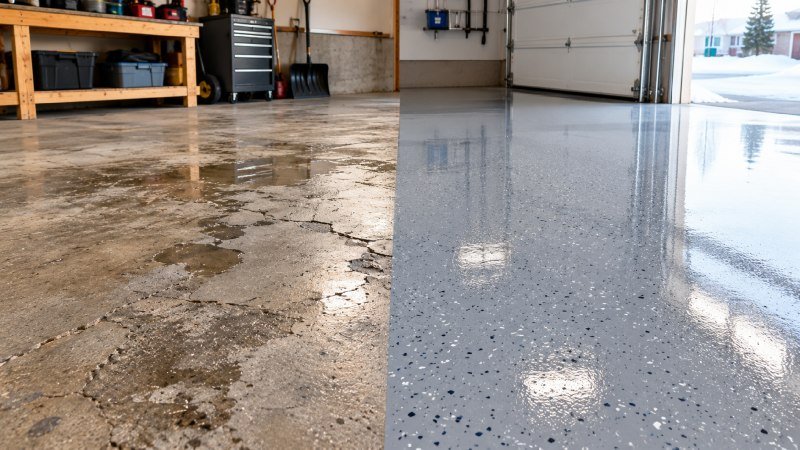
The Freeze-Thaw Reality Behind Calgary’s Flooring Problem
A concrete slab that looks fine in October can be cracked, pitted, and stained by March, and most homeowners never see the damage coming until it’s already done. Calgary’s temperature swings are not gentle; a chinook can push the mercury from minus twenty to above freezing within hours, and that kind of thermal shock puts enormous stress on untreated concrete. Moisture gets into hairline cracks, freezes, expands, and widens those cracks a little more each cycle. By the time spring arrives, what started as a cosmetic blemish has become a structural weak point that costs far more to fix than it would have to prevent.
This is not a problem unique to older homes or neglected garages. New builds in communities across the city are seeing the same deterioration within two or three winters if the slab was left bare or sealed with a low-grade coating. Road salt tracked in from driveways accelerates the chemical breakdown of the surface, and de-icing chemicals in particular are known to attack unprotected concrete at a much faster rate than plain water ever would. Combine that with the weight of vehicles rolling over the same tire paths day after day, and you get a surface that wears unevenly, develops dusting, and eventually starts flaking in sheets.
What Local Contractors Are Seeing on Job Sites This Year
Flooring crews working across Calgary this past season report a consistent pattern: homes without a proper protective coating are showing visible pitting within eighteen months, while coated floors in the same neighborhoods, installed around the same time, show almost none. The difference isn’t cosmetic preference, it’s chemistry. A properly applied epoxy system bonds to the concrete at a molecular level, sealing the pores that would otherwise soak up moisture, oil, and salt brine. That seal is what prevents the freeze-thaw cycle from ever getting a foothold in the first place.
Homeowners researching options for a basement, garage, or workshop floor are increasingly asking contractors for epoxy floor calgary specifically because the local installers understand how to prep a slab for this climate rather than applying a generic product meant for milder regions. Surface preparation matters as much as the coating itself; a slab that isn’t properly ground, cleaned, and moisture-tested will cause even a premium epoxy to peel within a year. Experienced crews test humidity levels in the concrete before they ever open a bucket, because skipping that step is the single most common reason coatings fail prematurely in this region.
Commercial sites have been slower to adopt these coatings than residential ones, partly because of scheduling pressure and partly because decision-makers underestimate how much downtime a failed floor eventually causes. A warehouse or shop floor that starts dusting creates a respiratory hazard for workers and a slip risk that insurers take seriously. Site safety reviews increasingly reference OSHA concrete construction safety standards when evaluating concrete work environments, since airborne dust and surface degradation are both flagged as conditions that demand corrective action rather than routine maintenance.
Getting the Timing and Prep Right Before Winter Sets In
Fall is the window contractors recommend most often, and there’s a practical reason for that beyond convenience. Epoxy coatings need a stretch of stable temperatures to cure properly, generally several days above ten degrees Celsius without a hard frost, and Calgary’s September and early October weather tends to offer exactly that. Waiting until the ground has already frozen means pushing the project into spring, which gives the slab another full winter of exposure before any protection goes down.
Homeowners planning ahead should budget time for the slab to dry out completely if it was recently poured or has had water sitting on it, since residual moisture trapped under a coating will cause bubbling and delamination later. A simple plastic sheet test, taping a square of poly to the concrete overnight and checking for condensation underneath, tells you most of what you need to know before calling a crew. It costs nothing and saves the expense of redoing a job that failed because the slab wasn’t ready.
Cost tends to be the question that comes up first in consultations, and it’s worth framing against the alternative rather than in isolation. Patching and repainting a bare concrete floor every two to three years adds up faster than most people expect, and the labor involved in grinding out old patch jobs before a proper coating can go down often exceeds the cost of doing it right the first time. A floor that’s prepped correctly and coated once tends to outlast two or three cycles of the patch-and-hope approach, which is really the calculation most homeowners are making whether they realize it or not.