
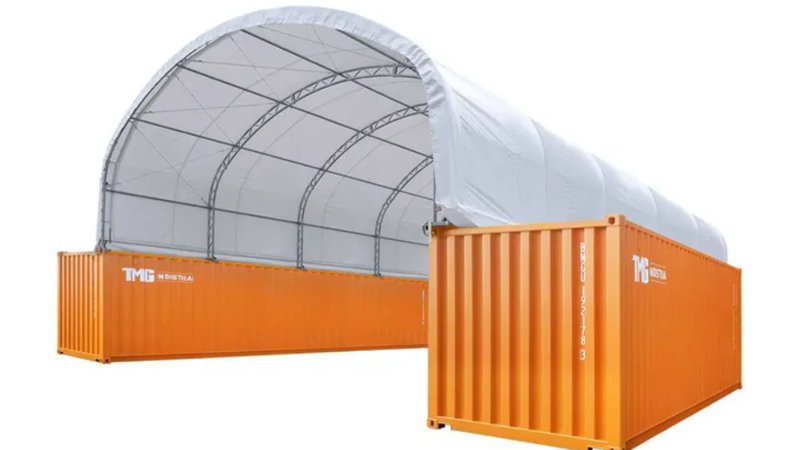
Across Canadian industrial sites, construction yards, and agricultural operations, covered storage for equipment and materials is often limited. Permanent building construction is expensive and time-consuming. A dual truss container shelter mounts on standard shipping containers to create weather-protected space without foundations or building permits. Canadian facilities use these structures to expand covered area quickly, protect equipment from snow and rain, and create semi-enclosed work zones.
Shipping containers are abundant across Canada. Converting them into support structures for fabric shelters uses their strength as anchors while adding covered space between them. This approach repurposes existing containers and avoids the cost of poured concrete footings.
Common Applications and Design Features
Dual truss container shelters are commonly used for:
- Equipment storage between container walls
- Covered loading and unloading areas
- Maintenance bays for vehicle repair
- Material stockpile protection from rain
- Seasonal storage for outdoor machinery
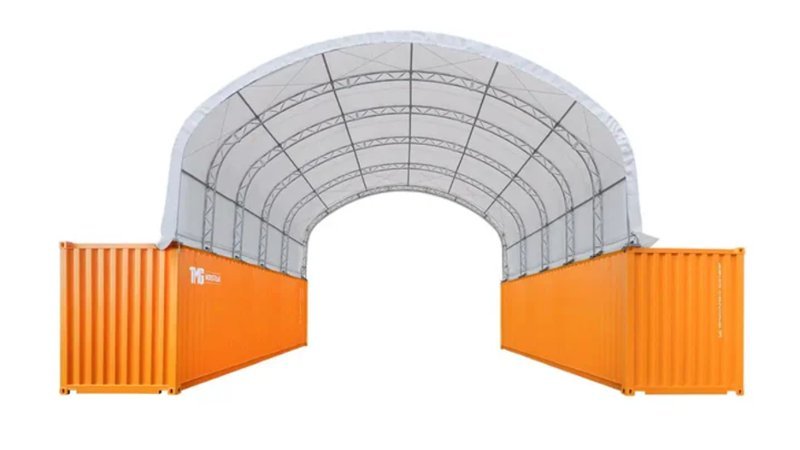
The shelter mounts on two standard shipping containers placed parallel to each other. The dual truss frame spans the gap between containers, creating covered space without interior support posts. The 17 ounce PVC cover provides weather protection while transmitting natural light. Truss spacing of 10 feet provides structural rigidity for snow loads. The 30 foot width and 40 foot length create approximately 600 square feet of covered space.
Container Integration and Structural Benefits
Compared with shelters built directly on the ground, using shipping containers as foundation walls provides a range of practical and structural benefits.Containers provide ready-made walls that can be locked for security. They elevate the shelter, allowing snow and water to drain underneath. The container roofs provide a stable mounting platform for the trusses. The weight of loaded containers anchors the shelter against wind uplift.
The dual truss design distributes loads across multiple frame members, providing safety margin during heavy snow events. Its galvanized steel structure is designed to withstand rust and deterioration caused by exposure to moisture and road salt.The PVC cover is flame-retardant for fire safety and UV-protected for sun resistance.
Technical Principles and Operational Considerations
Several factors affect shelter performance and longevity. The distance between containers determines the covered width. Container alignment must be parallel and level for proper truss fit. Truss attachment to container roofs requires bolted connections through the container roof structure. The PVC cover must be tensioned properly to prevent flapping and water pooling.
The shelter can be mounted on the outer or inner edges of containers. For harsh weather areas, mounting on outer edges creates a fully enclosed structure that prevents snow buildup outside. For areas requiring maximum interior clearance, inner edge mounting maximizes usable square footage.
Safety Practices and Maintenance Guidelines
To ensure safe setup and reliable operation, it is important to follow several essential guidelines:
- Ensure containers are level and stable before mounting
- Use proper lifting equipment for truss installation
- Verify cover tension is even across all trusses
- Inspect anchor bolts and frame connections regularly
- Remove snow accumulation during heavy winter storms
Maintenance includes inspecting the PVC cover for tears or UV degradation, checking frame bolts for tightness, cleaning gutters if installed, verifying container stability, and replacing damaged cover sections promptly. The cover should be replaced when fabric shows visible wear.
Advantages and Limitations
Advantages of a dual truss container shelter include:
- No foundation or building permit required
- Uses existing containers as support walls
- Dual truss design for snow load capacity
- 600 square feet of covered space
- Natural light transmission through PVC cover
- Lockable container walls for security
Limitations to consider:
- Requires two standard shipping containers
- Container roofs must support truss weight
- Not suitable for extreme snow loads
- PVC cover replacement needed after years
- Welding required for footplates
Real-World Application Example
A Canadian construction company in Alberta had two shipping containers used for tool storage. The gap between containers collected snow and was unusable space. The company installed a 30×40 dual truss shelter between the containers, creating covered space for equipment maintenance. The shelter protected mechanics from rain and snow during repairs. The containers remained accessible for tool storage. Workers added end walls later to create a fully enclosed workshop.
Conclusion and Future Outlook
TMG Industrial Dual Truss Container Shelters offer an efficient solution for creating additional covered storage or workspace by utilizing existing shipping containers as the supporting structure.This approach is valuable on sites where permanent construction is impractical. As Canadian industrial sites continue using containers for storage, demand for shelter systems that integrate with them will likely grow. Future designs may include insulated covers for winter use and solar panels for off-grid lighting.
Facility managers with existing container storage should evaluate dual truss shelters for any site requiring covered workspace between containers. The combination of dual truss strength and PVC cover durability makes this shelter suitable for diverse Canadian industrial applications.